
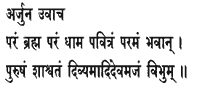
Arjuna said: Thou art the supreme Brahman, the supreme Abode, the supreme Purity, the one permanent, the divine Purusha, the original Godhead, the Unborn, the all-pervading Lord.
Works, Devotion and Knowledge
Sri Aurobindo
THIS THEN is the integral truth, the highest and widest knowledge. The Divine is supracosmic, the eternal Parabrahman who supports with his timeless and spaceless existence all this cosmic manifestation of his own being and nature in Space and Time. He is the supreme spirit who ensouls the forms and movements of the universe, Paramatman. He is the supernal Person of whom all self and nature, all being and becoming in this or any universe are the self-conception and the self-energising, Purushottama. He is the ineffable Lord of all existence who by his spiritual control of his own manifested Power in Nature unrolls the cycles of the world and the natural evolution of creatures in the cycles, Parameshwara. From him the Jiva, individual spirit, soul in Nature, existent by his being, conscious by the light of his consciousness, empowered to knowledge, to will and to action by his will and power, enjoying existence by his divine enjoyment of the cosmos, has come here into the cosmic rounds. The inner soul in man is here a partial self-manifestation of the Divine, self-limited for the works of his Nature in the universe, prakr.tir jı¯va-bhu¯ ta¯ . In his spiritual essence the individual is one with the Divine. In the works of the divine Prakriti he is one with him, yet there is an operative difference and many deep relations with God in Nature and with God above cosmic Nature. In the works of the lower appearance of Prakriti he seems by an ignorance and egoistic separation to be quite other than the One and to think, will, act, enjoy in this separative consciousness for the egoistic pleasure and purpose of his personal existence in the universe and its surface relations with other embodied minds and lives. But in fact all his being, all his thinking, all his willing and action and enjoyment are only a reflection— egoistic and perverted so long as he is in the ignorance—of the Divine’s being, the Divine’s thought, will, action and enjoyment of Nature. To get back to this truth of himself is his direct means of salvation, his largest and nearest door of escape from subjection to the Ignorance. Since he is a spirit, a soul with a nature of mind and reason, of will and dynamic action, of emotion and sensation and life’s seeking for the delight of existence, it is by turning all these powers Godwards that the return to the highest truth of himself can be made entirely possible. He must know with the knowledge of the supreme Self and Brahman; he must turn his love and adoration to the supreme Person; he must subject his will and works to the supreme Lord of cosmos. Then he passes from the lower to the divine Nature: he casts from him the thought and will and works of the Ignorance and thinks, wills and works in his divine identity as soul of that Soul, power and light of that Spirit; he enjoys all the inner infinite of the Divine and no longer only these outward touches, masks and appearances. Thus divinely living, thus directing his whole self and soul and nature Godwards, he is taken up into the truest truth of the supreme Brahman. To know Vasudeva as all and live in that knowledge is the secret. He knows him as the Self, immutable, continent of all as well as immanent in all things.He draws back from the confused and perturbed whirl of the lower nature to dwell in the still and inalienable calm and light of the self-existent spirit. There he realises a constant unity with this self of the Divine that is present in all existences and supports all cosmic movement and action and phenomenon. He looks upward from this eternal unchanging spiritual hypostasis of the mutable universe to the greater Eternal, the supracosmic, the Real. He knows him as the divine Inhabitant in all things that are, the Lord in the heart of man, the secret Ishwara, and removes the veil between his natural being and this inner spiritual Master of his being. He makes his will, thought and works one in knowledge with the Ishwara’s, attuned by an ever-present realisation to the sense of the indwelling Divinity, sees and adores him in all and changes the whole human action to the highest meaning of the divine nature. He knows him as the source and the substance of all that is around him in the universe. All things that are he sees as at once in their appearance the veils and in their secret trend the means and signs of self-manifestation of that one unthinkable Reality and everywhere discovers that oneness, Brahman, Purusha, Atman, Vasudeva, the Being that has become all these creatures. Therefore too his whole inner existence comes into tune and harmony with the Infinite now self-revealed in all that lives or is within and around him and his whole outer existence turns into an exact instrumentation of the cosmic purpose. He looks up through the Self to the Parabrahman who there and here is the one and only existence. He looks up through the divine Inhabitant in all to that supernal Person who in his supreme status is beyond all habitation. He looks up through the Lord manifested in the universe to the Supreme who exceeds and rules all his manifestation. Thus he arises through a limitless unfolding of knowledge and upward vision and aspiration to that to which he has turned with an all-compelling integrality, sarvabh¯avena. This integral turning of the soul Godwards bases royally the Gita’s synthesis of knowledge and works and devotion. To know God thus integrally is to know him as One in the self and in all manifestation and beyond all manifestation,—and all this unitedly and at once. And yet even so to know him is not enough unless it is accompanied by an intense uplifting of the heart and soul Godwards, unless it kindles a one-pointed and at the same time all-embracing love, adoration, aspiration. Indeed the knowledge which is not companioned by an aspiration and vivified by an uplifting is no true knowledge, for it can be only an intellectual seeing and a barren cognitive endeavour. The vision of God brings infallibly the adoration and passionate seeking of the Divine,—a passion for the Divine in his self-existent being, but also for the Divine in ourselves and for the Divine in all that is. To know with the intellect is simply to understand and may be an effective starting-point,—or, too, it may not be, and it will not be if there is no sincerity in the knowledge, no urge towards inner realisation in the will, no power upon the soul, no call in the spirit: for that would mean that the brain has externally understood, but inwardly the soul has seen nothing. True knowledge is to know with the inner being, and when the inner being is touched by the light, then it arises to embrace that which is seen, it yearns to possess, it struggles to shape that in itself and itself to it, it labours to become one with the glory of its vision. Knowledge in this sense is an awakening to identity and, since the inner being realises itself by consciousness and delight, by love, by possession and oneness with whatever of itself it has seen, knowledge awakened must bring an overmastering impulse towards this true and only perfect realisation. Here that which is known is not an externalised object, but the divine Purusha, self and lord of all that we are. An all-seizing delight in him and a deep and moved love and adoration of him must be the inevitable result and is the very soul of this knowledge. And this adoration is no isolated seeking of the heart, but an offering of the whole existence. Therefore it must take also the form of a sacrifice; there is a giving of all our works to the Ishwara, there is a surrender of all our active inward and outward nature to the Godhead of our adoration in its every subjective and in its every objective movement. All our subjective workings move in him and they seek him, the Lord and Self, as the source and goal of their power and endeavour. All our objective workings move out towards him in the world and make him their object, initiate a service of God in the world of which the controlling power is the Divinity within us in whom we are one self with the universe and its creatures. For both world and self, Nature and the soul in her are enlightened by the consciousness of the One, are inner and outer bodies of the transcendent Purushottama. So comes a synthesis of mind and heart and will in the one self and spirit and with it the synthesis of knowledge, love and works in this integral union, this embracing God-realisation, this divine Yoga. But to arrive at this movement at all is difficult for the egobound nature. And to arrive at its victorious and harmonious integrality is not easy even when we have set our feet on the way finally and for ever. Mortal mind is bewildered by its ignorant reliance upon veils and appearances; it sees only the outward human body, human mind, human way of living and catches no liberating glimpse of the Divinity who is lodged in the creature. It ignores the divinity within itself and cannot see it in other men, and even though the Divine manifest himself in humanity as Avatar and Vibhuti, it is still blind and ignores or despises the veiled Godhead, avaja¯nanti ma¯m˙ mu¯d. ha¯ ma¯nus.ı¯m˙ tanum ¯a´sritam. And if it ignores him in the living creature, still less can it see him in the objective world on which it looks out from its prison of separative ego through the barred windows of the finite mind. It does not see God in the universe; it knows nothing of the supreme Divinity who is master of these planes full of various existences and dwells within them; it is blind to the vision by which all in the world grows divine and the soul itself awakens to its own inherent divinity and becomes of the Godhead, godlike. What it does see readily, and to that it attaches itself with passion, is only the life of the ego hunting after finite things for their own sake and for the satisfaction of the earthly hunger of the intellect, body, senses. Those who have given themselves up too entirely to this outward drive of the mentality, fall into the hands of the lower nature, cling to it and make it their foundation. They become a prey to the nature of the Rakshasa in man who sacrifices everything to a violent and inordinate satisfaction of his separate vital ego and makes that the dark godhead of his will and thought and action and enjoyment. Or they are hurried onward in a fruitless cycle by the arrogant self-will, self-sufficient thought, self-regarding act, self-satisfied and yet ever unsatisfied intellectualised appetite of enjoyment of the Asuric nature. But to live persistently in this separative ego-consciousness and make that the centre of all our activities is to miss altogether the true self-awareness. The charm it throws upon the misled instruments of the spirit is an enchantment that chains life to a profitless circling. All its hope, action, knowledge are vain things when judged by the divine and eternal standard, for it shuts out the great hope, excludes the liberating action, banishes the illuminating knowledge. It is a false knowledge that sees the phenomenon but misses the truth of the phenomenon, a blind hope that chases after the transient but misses the eternal, a sterile action whose every profit is annulled by loss and amounts to a perennial labour of Sisyphus.1 The great-souled who open themselves to the light and largeness of the diviner nature of which man is capable, are alone on the path narrow in the beginning, inexpressibly wide in the end that leads to liberation and perfection. The growth of the god in man is man’s proper business; the steadfast turning of this lower Asuric and Rakshasic into the divine nature is the carefully hidden meaning of human life. As this growth increases, the veil falls and the soul comes to see the greater significance of action and the real truth of existence. The eye opens to the Godhead in man, to the Godhead in the world; it sees inwardly and comes to know outwardly the infinite Spirit, the Imperishable from whom all existences originate and who exists in all and by him and in him all exist always. Therefore when this vision, this knowledge seizes on the soul, its whole life-aspiration becomes a surpassing love and fathomless adoration of the Divine and Infinite. The mind attaches itself singly to the eternal, the spiritual, the living, the universal, the Real; it values nothing but for its sake, it delights only in the all-blissful Purusha. All the word and all the thought become one hymning of the universal greatness, Light, Beauty, Power and Truth that has revealed itself in its glory to the human spirit and a worship of the one supreme Soul and infinite Person. All the long stress of the inner self to break outward becomes a form now of spiritual endeavour and aspiration to possess the Divine in the soul and realise the Divine in the nature. All life becomes a constant Yoga and unification of that Divine and this human spirit. This is the manner of the integral devotion; it creates a single uplifting of our whole being and nature through sacrifice by the dedicated heart to the eternal Purushottama.2 Those who lay a predominant stress on knowledge, arrive to the same point by an always increasing, engrossing, enforcing power of the vision of the Divine on the soul and the nature. Theirs is the sacrifice of knowledge and by an ineffable ecstasy
of knowledge they come to the adoration of the Purushottama, jn˜ a¯na-yajn˜ ena yajanto ma¯m upa¯sate. This is a comprehension filled with Bhakti, because it is integral in its instruments, integral in its objective. It is not a pursuit of the Supreme merely as an abstract unity or an indeterminable Absolute. It is a heartfelt seeking and seizing of the Supreme and the Universal, a pursuit of the Infinite in his infinity and of the Infinite in all that is finite, a vision and embracing of the One in his oneness and of the One in all his several principles, his innumerable visages, forces, forms, here, there, everywhere, timelessly and in time, multiply, multitudinously, in endless aspects of his Godhead, in beings without number, all his million universal faces fronting us in the world and its creatures, ekatvena pr.thaktvena bahudh¯a vi´svatomukham. This knowledge becomes easily an adoration, a large devotion, a vast self-giving, an integral self-offering because it is the knowledge of a Spirit, the contact of a Being, the embrace of a supreme and universal Soul which claims all that we are even as it lavishes on us when we approach it all the treasures of its endless delight of existence.3 The way of works too turns into an adoration and a devotion of self-giving because it is an entire sacrifice of all our will and its activities to the one Purushottama. The outward Vedic rite is a powerful symbol, effective for a slighter though still a heavenward purpose; but the real sacrifice is that inner oblation in which the Divine All becomes himself the ritual action, the sacrifice and every single circumstance of the sacrifice. All the working and forms of that inner rite are the self-ordinance and self-expression of his power in us mounting by our aspiration towards the source of its energies. The Divine Inhabitant becomes himself the flame and the offering, because the flame is the Godward will and that will is God himself within us. And the offering too is form and force of the constituent Godhead in our nature and being; all that has been received from him is given up to the service and the worship of its own Reality,
its own supreme Truth and Origin. The Divine Thinker becomes himself the sacred mantra; it is the Light of his being that expresses itself in the thought directed Godward and is effective in the revealing word of splendour that enshrines the thought’s secret and in the rhythm that repeats for man the rhythms of the Eternal. The illumining Godhead is himself the Veda and that which is made known by the Veda. He is both the knowledge and the object of the knowledge. The Rik, the Yajur, the Sama, the word of illumination which lights up the mind with the rays of knowledge, the word of power for the right ordaining of action, the word of calm and harmonious attainment for the bringing of the divine desire of the spirit, are themselves the Brahman, the Godhead. The mantra of the divine Consciousness brings its light of revelation, the mantra of the divine Power its will of effectuation, the mantra of the divine Ananda its equal fulfilment of the spiritual delight of existence. All word and thought are an outflowering of the great OM,—OM, the Word, the Eternal. Manifest in the forms of sensible objects, manifest in that conscious play of creative selfconception of which forms and objects are the figures, manifest behind in the self-gathered superconscient power of the Infinite, OM is the sovereign source, seed, womb of thing and idea, form and name,—it is itself, integrally, the supreme Intangible, the original Unity, the timeless Mystery self-existent above all manifestation in supernal being.4 This sacrifice is therefore at once works and adoration and knowledge.5 To the soul that thus knows, adores, offers up all its workings in a great self-surrender of its being to the Eternal, God is all and all is the Godhead. It knows God as the Father of this world who nourishes and cherishes and watches over his children. It knows God as the divine Mother who holds us in her bosom, lavishes upon us the sweetness of her love and fills the universe with her forms of beauty. It knows him as the first Creator from
whom has originated all that originates and creates in space and time and relation. It knows him as the Master and ordainer of all universal and of every individual dispensation. The world and fate and uncertain eventuality cannot terrify, the aspect of suffering and evil cannot bewilder the man who has surrendered himself to the Eternal. God to the soul that sees is the path and God is the goal of his journey, a path in which there is no selflosing and a goal to which his wisely guided steps are surely arriving at every moment. He knows the Godhead as the master of his and all being, the upholder of his nature, the husband of the nature-soul, its lover and cherisher, the inner witness of all his thoughts and actions. God is his house and country, the refuge of his seekings and desires, the wise and close and benignant friend of all beings. All birth and status and destruction of apparent existences is to his vision and experience the One who brings forward, maintains and withdraws his temporal selfmanifestation in its system of perpetual recurrences. He alone is the imperishable seed and origin of all that seem to be born and perish and their eternal resting-place in their non-manifestation. It is he that burns in the heat of the sun and the flame; it is he who is the plenty of the rain and its withholding; he is all this physical Nature and her workings. Death is his mask and immortality is his self-revelation. All that we call existent is he and all that we look upon as non-existent still is there secret in the Infinite and is part of the mysterious being of the Ineffable.6 Nothing but the highest knowledge and adoration, no other way than an entire self-giving and surrender to this Highest who is all, will bring us to the Highest. Other religion, other worship, other knowledge, other seeking has always its fruits, but these are transient and limited to the enjoyment of divine symbols and appearances. There are always open for our following according to the balance of our mentality an outer and an inmost knowledge, an outer and an inmost seeking. Outward religion is the worship of an outward deity and the pursuit of an external beatitude: its devotees purify their conduct from sin and attain
to an active ethical righteousness in order to satisfy the fixed law, the Shastra, the external dispensation; they perform the ceremonial symbol of the outer communion. But their object is to secure after the mortal pleasure and pain of earthly life the bliss of heavenly worlds, a greater happiness than earth can give but still a personal and mundane enjoyment though in a larger world than the field of this limited and suffering terrestrial nature. And to that to which they aspire, they attain by faith and right endeavour; for material existence and earthly activities are not the whole scope of our personal becoming or the whole formula of the cosmos.Other worlds there are of a larger felicity, svargalokam˙ vis´a¯lam. Thus the Vedic ritualist of old learned the exoteric sense of the triple Veda, purified himself from sin, drank the wine of communion with the gods and sought by sacrifice and good deeds the rewards of heaven. This firm belief in a Beyond and this seeking of a diviner world secures to the soul in its passing the strength to attain to the joys of heaven on which its faith and seekingwere centred: but the return to mortal existence imposes itself because the true aim of that existence has not been found and realised.Here and not elsewhere the highest Godhead has to be found, the soul’s divine nature developed out of the imperfect physical human nature and through unity with God and man and universe the whole large truth of being discovered and lived and made visibly wonderful. That completes the long cycle of our becoming and admits us to a supreme result; that is the opportunity given to the soul by the human birth and, until that is accomplished, it cannot cease. The God-lover advances constantly towards this ultimate necessity of our birth in cosmos through a concentrated love and adoration by which he makes the supreme and universal Divine the whole object of his living—not either egoistic terrestrial satisfaction or the celestial worlds—and the whole object of his thought and his seeing. To see nothing but the Divine, to be at every moment in union with him, to love him in all creatures and have the delight of him in all things is the whole condition of his spiritual existence. His Godvision does not divorce him from life, nor does he miss anything of the fullness of life; for God himself becomes the spontaneous
bringer to him of every good and of all his inner and outer getting and having, yoga-ks.emam˙ vaha¯myaham. The joy of heaven and the joy of earth are only a small shadow of his possessions; for as he grows into the Divine, the Divine too flows out upon him with all the light, power and joy of an infinite existence.7 Ordinary religion is a sacrifice to partial godheads other than the integral Divinity. The Gita takes its direct examples from the old Vedic religion on its exoteric side as it had then developed; it describes this outward worship as a sacrifice to other godheads, anya-devat¯ah. , to the gods, or to the divinised Ancestors, or to elemental powers and spirits, dev¯an, pit¯r. n, bhu¯ ta¯ni. Men consecrate their life and works ordinarily to partial powers or aspects of the divine Existence as they see or conceive them— mostly powers and aspects that ensoul to them things prominent in Nature and man or else reflect to them their own humanity in a divine exceeding symbol. If they do this with faith, then their faith is justified; for the Divine accepts whatever symbol, form or conception of himself is present to the mind of the worshipper, ya¯m˙ ya¯m˙ tanum˙ s´raddhaya¯ arcati, as it is said elsewhere, and meets him according to the faith that is in him. All sincere religious belief and practice is really a seeking after the one supreme and universal Godhead; for he always is the sole master of man’s sacrifice and askesis and infinite enjoyer of his effort and aspiration. However small or low the form of the worship, however limited the idea of the godhead, however restricted the giving, the faith, the effort to get behind the veil of one’s own egoworship and limitation by material Nature, it yet forms a thread of connection between the soul of man and the All-soul and there is a response. Still the response, the fruit of the adoration and offering is according to the knowledge, the faith and the work and cannot exceed their limitations, and therefore from the point of view of the greater God-knowledge, which alone gives the entire truth of being and becoming, this inferior offering is not given according to the true and highest law of the sacrifice. It is not founded on a knowledge of the supreme Godhead in his integral
existence and the true principles of his self-manifestation, but attaches itself to external and partial appearances,—na m¯am abhij ¯ ananti tattvena. Therefore its sacrifice too is limited in its object, largely egoistic in its motive, partial and mistaken in its action and its giving, yajanti avidhi-pu¯rvakam. An entire seeing of the Divine is the condition of an entire conscious selfsurrender; the rest attains to things that are incomplete and partial, and has to fall back from them and return to enlarge itself in a greater seeking and wider God-experience. But to follow after the supreme and universal Godhead alone and utterly is to attain to all knowledge and result which other ways acquire, while yet one is not limited by any aspect, though one finds the truth of him in all aspects. This movement embraces all forms of divine being on its way to the supreme Purushottama.8 This absolute self-giving, this one-minded surrender is the devotion which the Gita makes the crown of its synthesis. All action and effort are by this devotion turned into an offering to the supreme and universal Godhead. “Whatever thou doest, whatever thou enjoyest, whatever thou sacrificest, whatever thou givest, whatever energy of tapasya, of the soul’s will or effort thou puttest forth, make it an offering unto Me.” Here the least, the slightest circumstance of life, the most insignificant gift out of oneself or what one has, the smallest action assumes a divine significance and it becomes an acceptable offering to the Godhead who makes it a means for his possession of the soul and life of the God-lover. The distinctions made by desire and ego then disappear. As there is no straining after the good result of one’s action, no shunning of unhappy result, but all action and result are given up to the Supreme to whom all work and fruit in the world belong for ever, there is no farther bondage. For by an absolute self-giving all egoistic desire disappears from the heart and there is a perfect union between the Divine and the individual soul through an inner renunciation of its separate living. All will, all action, all result become that of the Godhead, work divinely through the purified and illumined nature and no
longer belong to the limited personal ego. The finite nature thus surrendered becomes a free channel of the Infinite; the soul in its spiritual being, uplifted out of the ignorance and the limitation, returns to its oneness with the Eternal. The Divine Eternal is the inhabitant in all existences; he is equal in all and the equal friend, father, mother, creator, lover, supporter of all creatures. He is the enemy of none and he is the partial lover of none; none has he cast out, none has he eternally condemned, none has he favoured by any despotism of arbitrary caprice: all at last equally come to him through their circlings in the ignorance. But it is only this perfect adoration that can make this indwelling of God in man and man in God a conscious thing and an engrossing and perfect union. Love of the Highest and a total self-surrender are the straight and swift way to this divine oneness.9 The equal Divine Presence in all of us makes no other preliminary condition, if once this integral self-giving has been made in faith and in sincerity and with a fundamental completeness. All have access to this gate, all can enter into this temple: our mundane distinctions disappear in the mansion of the All-lover. There the virtuous man is not preferred, nor the sinner shut out from the Presence; together by this road the Brahmin pure of life and exact in observance of the law and the outcaste born from a womb of sin and sorrow and rejected of men can travel and find an equal and open access to the supreme liberation and the highest dwelling in the Eternal. Man and woman find their equal right before God; for the divine Spirit is no respecter of persons or of social distinctions and restrictions: all can go straight to him without intermediary or shackling condition. “If” says the divine Teacher “even a man of very evil conduct turns to me with a sole and entire love, he must be regarded as a saint, for the settled will of endeavour in him is a right and complete will. Swiftly he becomes a soul of righteousness and obtains eternal peace.” In other words a will of entire self-giving opens wide all the gates of the spirit and brings in response an entire descent and self-giving of the Godhead to the human being, and that at
once reshapes and assimilates everything in us to the law of the divine existence by a rapid transformation of the lower into the spiritual nature. The will of self-giving forces away by its power the veil between God and man; it annuls every error and annihilates every obstacle. Those who aspire in their human strength by effort of knowledge or effort of virtue or effort of laborious self-discipline, grow with much anxious difficulty towards the Eternal; but when the soul gives up its ego and its works to the Divine, God himself comes to us and takes up our burden. To the ignorant he brings the light of the divine knowledge, to the feeble the power of the divine will, to the sinner the liberation of the divine purity, to the suffering the infinite spiritual joy and Ananda. Their weakness and the stumblings of their human strength make no difference. “This is my word of promise,” cries the voice of the Godhead to Arjuna, “that he who loves me shall not perish.” Previous effort and preparation, the purity and the holiness of the Brahmin, the enlightened strength of the king-sage great in works and knowledge have their value, because they make it easier for the imperfect human creature to arrive at this wide vision and self-surrender; but even without this preparation all who take refuge in the divine Lover of man, the Vaishya once preoccupied with the narrowness of wealthgetting and the labour of production, the Shudra hampered by a thousand hard restrictions, woman shut in and stunted in her growth by the narrow circle society has drawn around her self-expansion, those too, p¯apa-yonayah. , on whom their past Karma has imposed even the very worst of births, the outcaste, the Pariah, the Chandala, find at once the gates of God opening before them. In the spiritual life all the external distinctions of which men make so much because they appeal with an oppressive force to the outward mind, cease before the equality of the divine Light and the wide omnipotence of an impartial Power.10 The earthly world preoccupied with the dualities and bound to the immediate transient relations of the hour and the moment is for man, so long as he dwells here attached to these things
and while he accepts the law they impose on him for the law of his life, a world of struggle, suffering and sorrow. The way to liberation is to turn from the outward to the inward, from the appearance created by the material life which lays its burden on the mind and imprisons it in the grooves of the life and the body to the divine Reality which waits to manifest itself through the freedom of the spirit. Love of the world, the mask, must change into the love of God, the Truth. Once this secret and inner Godhead is known and is embraced, the whole being and the whole life will undergo a sovereign uplifting and a marvellous transmutation. In place of the ignorance of the lower Nature absorbed in its outward works and appearances the eye will open to the vision of God everywhere, to the unity and universality of the spirit. The world’s sorrow and pain will disappear in the bliss of the All-blissful; our weakness and error and sin will be changed into the all-embracing and all-transforming strength, truth and purity of the Eternal. To make the mind one with the divine consciousness, to make the whole of our emotional nature one love of God everywhere, to make all our works one sacrifice to the Lord of the worlds and all our worship and aspiration one adoration of him and self-surrender, to direct the whole self Godwards in an entire union is the way to rise out of a mundane into a divine existence. This is the Gita’s teaching of divine love and devotion, in which knowledge, works and the heart’s longing become one in a supreme unification, a merging of all their divergences, an intertwining of all their threads, a high fusion, a wide identifying movement.11
Sri Aurobindo
 About Us | ©1999 - 2009 searchforlight.org
All extracts and quotations from the written works of Sri Aurobindo and the Mother and the Photographs of
the Mother and Sri Aurobindo are copyright Sri Aurobindo Ashram Trust, Pondicherry -605002 India.